The bug we'd have chased for a week, we found by lunchtime
How an AI-built diagnostic tool caught two hidden checkout bugs on a busy online store in hours, and why an engineer still makes the fix.


Bringing AI into the day-to-day running of accounts has made us quicker and more reliable. What it has not done is change a single thing about what we actually deliver to you. I want to explain both halves of that, because the second half matters just as much as the first.
There is a fair worry buried in all the AI talk at the moment, which is that agencies will use it as cover to do less and charge the same. So let me put the conclusion first, before anyone has to wonder: we brought it in to do more for you, and the proof is simply in where the freed-up time goes. If you cannot feel the benefit, we have used it incorrectly.
The one making the biggest difference is AI meeting transcription and note-taking. It listens to the whole conversation, then helps us turn it into accurate minutes and a clear list of actions right after the call ends. If you have ever walked out of a meeting full of good intentions and watched half of them quietly evaporate by Friday, you will understand why this matters. Nothing gets missed. Everything we agreed is written down and tracked. And the write-up reaches you in hours, while it is still fresh, rather than landing days later when the moment has passed.
There is a subtler benefit, too, and it might be the one I value most. When a person is no longer trying to scribble notes and stay in the conversation at the same time, they are simply more present in your meeting. They listen better. They ask the follow-up question instead of missing it because they were three sentences behind, writing. The note-taking running quietly in the background frees your account manager to do the thing you are actually paying them for: think about your business while you are talking about it.
The effect shows up in the small things. The action you mentioned in passing, forty minutes into a call, no longer rides on someone remembering it later. The decision you thought you had made, but were not quite sure about, is there in black and white the same afternoon. None of that is dramatic on any single day. Over a quarter of it compounds into a relationship where nothing quietly slips through the gaps, which is worth a great deal more than it sounds.
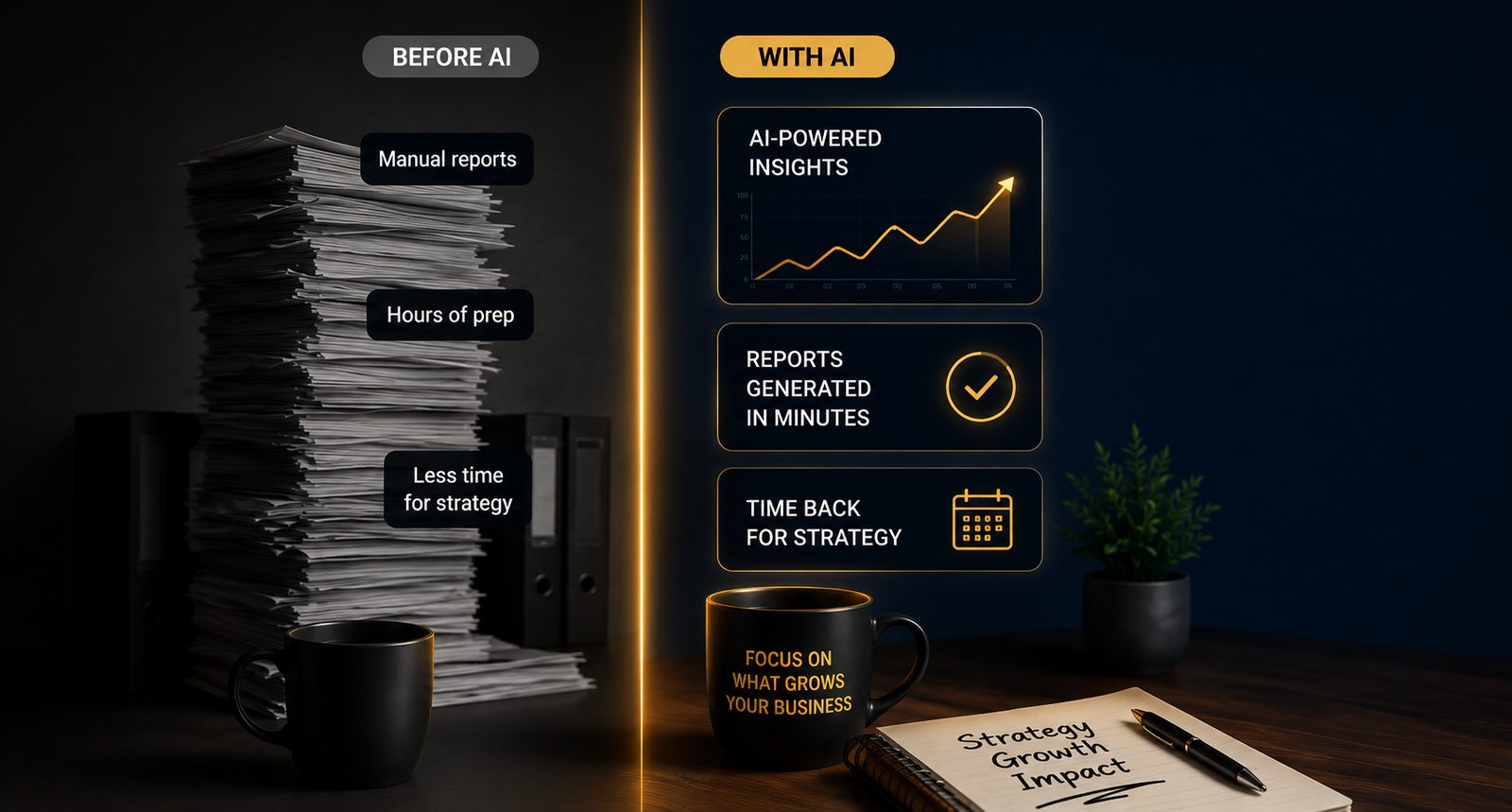
We are also using AI to speed up the building of decks and reports. The formatting and assembly that used to swallow hours now takes a fraction of the time, which frees the team to focus on the thinking behind a report rather than wrestling with where the chart goes. A report should be judged on what it tells you, not on how long it took to lay out, and AI has finally made that true.
I should be clear about the limit, though. The AI does not decide what your numbers mean. It assembles the report quickly so a person can spend their time on the interpretation, the so-what, and the recommendation that follows from the data. A fast deck full of charts and no thinking would be worse than a slow one, not better, and we both know which of those you are actually paying for.
We lean on it to brainstorm and pressure-test ideas, as well. Before a recommendation reaches you, it has often been argued with, stress-tested and improved, sometimes by bouncing it off an AI to find the holes before you do. So what lands on your desk has already been kicked around, not dreamed up on the way to the meeting. Add it all up and the point is simple: more of our time goes into your strategy and the actual problem-solving, and less into the admin that never needed a human in the first place.
Here is the part I am most firm about. We keep a person across all of it. AI helps us move faster and stay accurate, but it does not get the final word on anything that matters to you. Every set of minutes, every deck, and every recommendation is reviewed and owned by your dedicated account manager before it reaches you. The machine drafts and assists. Your account manager decides and stands behind what they send.
I am wary of the version of this story where an agency quietly automates the relationship and hopes the client will not notice. That is the opposite of what we are doing. We are automating the parts that were keeping us from you, so that the time we spend on your account is spent on you. The whole reason for bringing AI in was to give you more of our attention, not less. If it ever started to feel like less, we would know we had got it wrong.
This is also why we have not quietly replaced a single account manager with a chatbot, and we are not going to. The tools change what your account manager spends the day on. They do not change who is responsible for your account or who picks up the phone when you need them. Less time on the busywork, more on you. That was the whole point, and it is the test we will keep holding ourselves to. If we ever stop passing that test, I would want to hear about it, because the entire point of all this was to serve you better, not to serve ourselves more cheaply.
How an AI-built diagnostic tool caught two hidden checkout bugs on a busy online store in hours, and why an engineer still makes the fix.

AI design tools in Canva and Photoshop let us show clients real options in the room. Why a designer still makes every final call on brand.

How an AI-native code editor turned a fortnight's courier integration into an hour's first draft, and why the saved time goes into testing and polish.
Book a free call and we will show you where AI-native marketing can grow your business.
Book a call ↗